
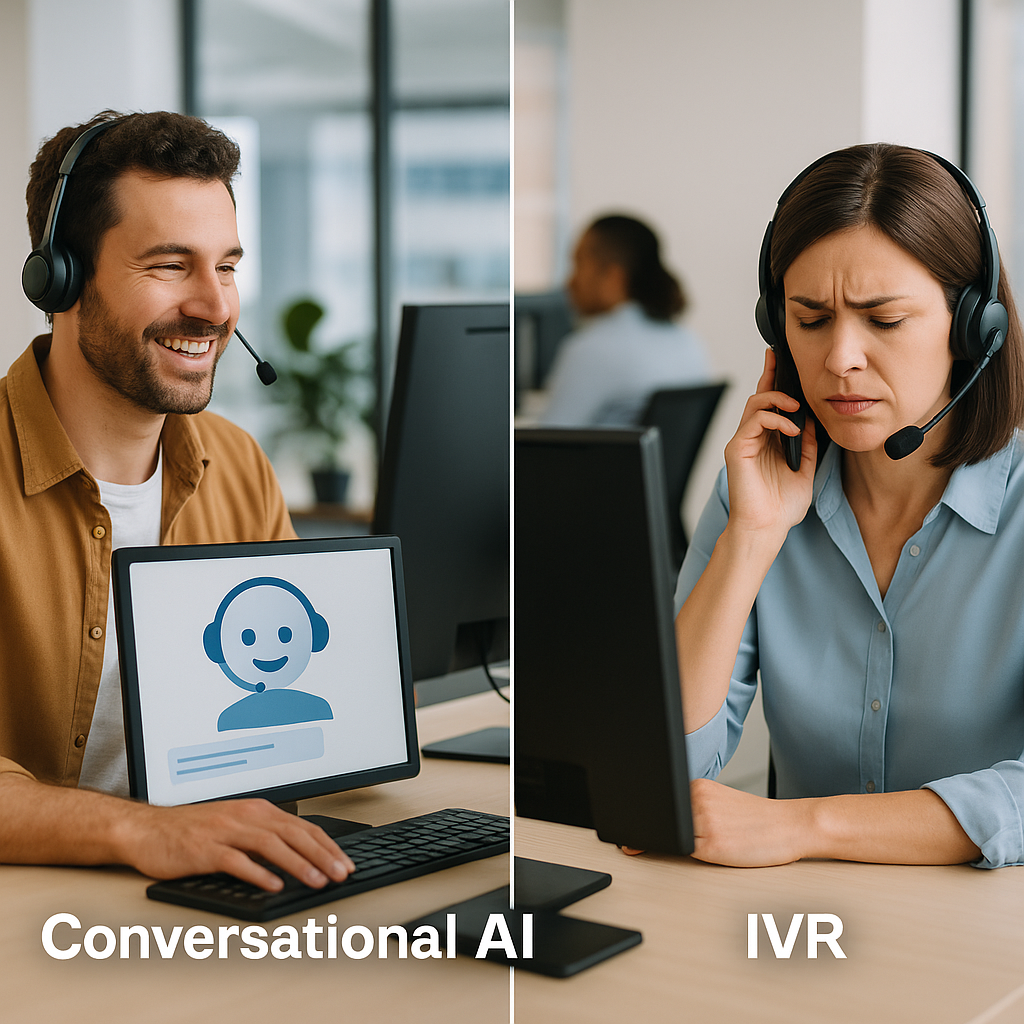
We’ve all been there — calling customer service for something simple, only to get trapped in a maze of “Press 1 for billing” and “Press 2 for support.” You wait, you sigh, you mash zero hoping to reach a human.
That system, of course, is IVR — Interactive Voice Response — a technology built to make service faster but not necessarily friendlier.
Now, step into 2026. You call the same company, but this time you’re greeted by a calm, natural-sounding voice that actually listens. You say, “I’m having trouble with my payment,” and it instantly knows who you are, what you meant, and how to help. That’s Conversational AI, and it’s quietly rewriting the rules of customer experience.
From Menus to Meaningful Conversations
When IVR launched decades ago, it was revolutionary. It saved time, cut costs, and handled thousands of calls a day. But technology aged, and customer expectations didn’t wait around.
By contrast, Conversational AI feels alive. It remembers each and everything be it your past, natural speech, and then it reacts empathetically. It adjusts itself as per the people rather than making them fit into its processes.
What distinguishes Conversational AI from IVR today is that transition from inflexible scripts to actual discussions.
Why Conversational AI Is Winning in 2026
1. It Speaks Human
Conversational AI doesn’t ask you to pick a number. You just talk, and it gets it. It understands intent, slang, even frustration. If you sound upset, it can soften its tone or escalate you faster. It feels less like “tech support” and more like talking to a knowledgeable coworker who actually cares.
2. It Remembers You
The biggest strength of AI is its memory. Everything is being tracked from your recent purchase to even your preferred method of communication. This implies that reaching out again is a continuation rather than a cold restart. In contrast, an IVR handles each call as if it were a new one.
3. It Is Never Sleeping
Conversational AI does not require coffee breaks. It is ready 24/7 to help customers in various time zones and on vacation. Businesses adore the dependability, and customers appreciate the prompt service This win-win scenario cannot be replicated by IVR without human backup.
4. Every Channel Is Connected
In 2026, customers bounce between chat, voice, email, and messaging apps. Conversational AI follows the thread across them all. You can start on a website chat and finish over the phone — no repeating yourself. IVR, stuck in its phone-only bubble, feels dated in comparison.
The Problem with IVR: It Feels Like a Wall
Let’s be honest — IVR isn’t bad tech. It’s just cold.
It doesn’t listen; it processes. It doesn’t understand; it categorizes.
That’s why customers often get frustrated before they even reach a person. In one recent study, over two-thirds of callers admitted they’d rather hang up than fight through another long IVR menu.
Conversational AI flips that frustration into relief. It recognizes context, predicts intent, and gets people where they need to go without the endless wait. It turns “another call” into a conversation.
Humans and AI: The New CX Dream Team
Here’s the truth: AI isn’t here to replace people — it’s here to help them.
In the best-run call centers doctors, Conversational AI handles repetitive, low-value tasks while humans focus on empathy-heavy or complex problems. The hand-off is seamless — AI gives the agent full context, so no one has to start over with “Can you tell me what’s going on again?”
This partnership makes service faster, friendlier, and far less frustrating — for both sides of the line.
The Payoff for Businesses
Brands adopting Conversational AI are seeing dramatic results: shorter resolution times, higher CSAT scores, and leaner support costs. More importantly, customers leave feeling understood.
IVR is static whereas AI keeps evolving every day. With every interaction its accuracy, tone, and response timing is being evaluated. In short, the more it talks, the smarter — and more human — it gets.
The Verdict: The Future of CX Speaks Human
The Conversational AI vs IVR debate isn’t just about automation anymore. It’s about empathy. IVR taught us efficiency. Conversational AI teaches us understanding.
In 2026, best customer experience is going to be measured by how quickly a call begins rather than how quickly it ends. Conversational AI listens, learns, and responds — not like a machine, but like a human who’s simply powered by one.